

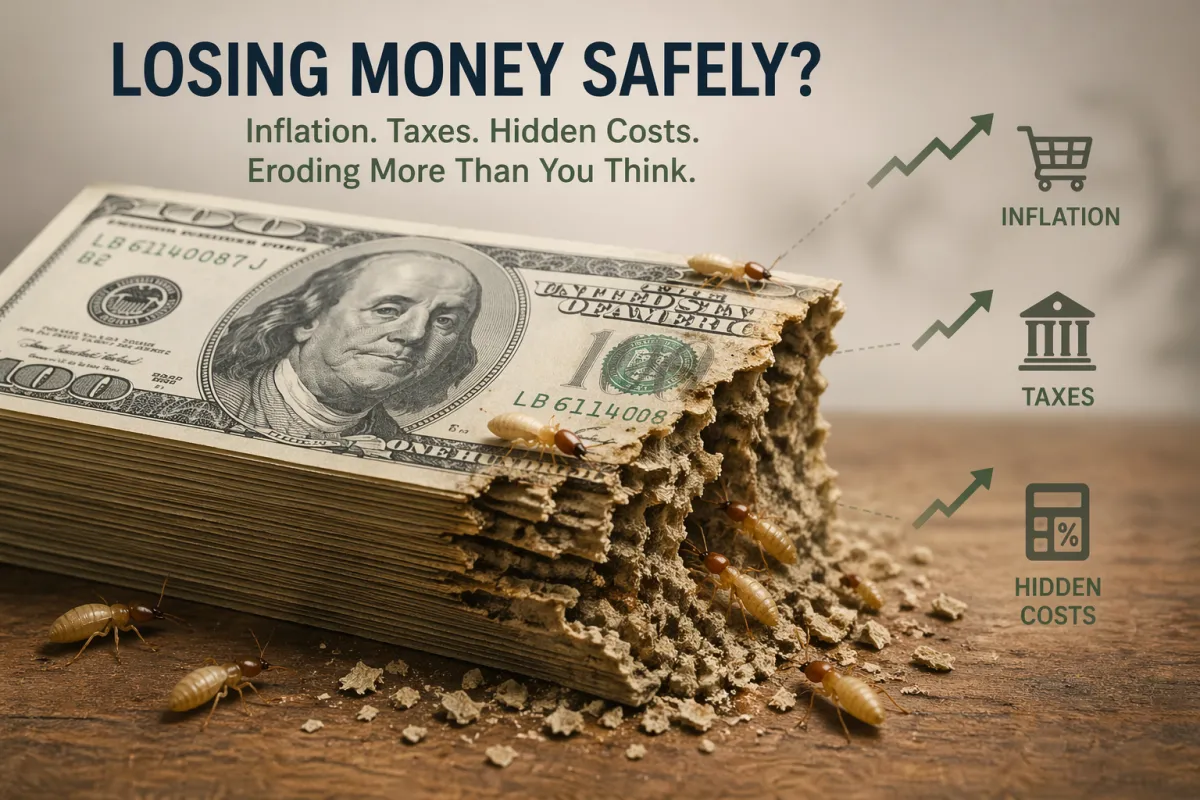
Are You “Losing Money Safely” in Retirement? Rethinking Cash, CDs, and Security
In a recent Retirement Compass Radio Show episode, Jeff Gove and John Ternus of Stonebridge Wealth Systems discussed a topic that’s especially relevant in today’s environment: the growing comfort retirees feel with cash, CDs, and money market accounts—and the potential risks that come with relying on them too heavily.
While higher interest rates have made these options more attractive than they were in years past, the conversation highlighted an important reality: what feels safe on the surface may not always support long-term financial security.
The Illusion of Safety in Cash
After years of near-zero interest rates, today’s environment—where CDs and money markets may offer roughly 3% to 4%—can feel like a welcome change. For many retirees, this creates a sense of stability and control.
However, as discussed on the show, stability in account value does not necessarily translate into preserved purchasing power. Inflation, even at more moderate levels, continues to erode what those dollars can actually buy over time. When inflation outpaces or closely matches the return on cash, the real value of those savings can decline.
Jeff Gove referred to this dynamic as “losing money safely”—a situation where account balances don’t decrease, but their real-world buying power does.
Taxes: The Often Overlooked Factor
Another key consideration is taxation. Interest earned from CDs and money market accounts is generally taxed as ordinary income, regardless of whether the funds are withdrawn.
For example, a 4% return may appear attractive at first glance. But after accounting for federal (and potentially state) taxes, the net return could be meaningfully lower. In some cases, this reduced after-tax return may fall below the rate of inflation, further compounding the loss of purchasing power.
As emphasized during the discussion, what ultimately matters is not just what you earn—but what you keep after taxes.
When “Safe” Becomes Risky
The episode also explored how holding excessive amounts of cash can introduce unintended risks. One example shared involved a retiree who had accumulated over $400,000 across multiple bank accounts. While maintaining liquidity for emergencies is important, the question becomes: how much is necessary?
Keeping more cash than needed for short-term expenses may limit the opportunity for long-term growth. Additionally, concentrating assets in similar low-yield, tax-inefficient vehicles may not provide the diversification many investors believe they have.
True diversification involves balancing different asset types with varying risk, return, and tax characteristics—not simply spreading funds across multiple accounts or institutions.
The Impact of Inflation Over Time
Inflation does not need to be at historically high levels to have an impact. Even at more typical rates—around 2.5% to 3.5%—it can steadily reduce purchasing power.
When combined with taxes, the net effect can be significant. For instance, a nominal return of 4% may effectively translate to closer to 3% (or less) after taxes, potentially trailing inflation. Over time, this gap can erode the real value of savings, particularly for retirees relying on those assets for income.
Why Timing the Market Isn’t the Answer
Some investors respond to uncertainty by moving heavily into cash, waiting for a perceived “better time” to invest. However, the show highlighted the challenges of this approach.
Market timing is inherently difficult, and missing even a small number of strong market days can significantly impact long-term returns. One example shared noted that staying fully invested over a 25-year period produced substantially better outcomes than missing just the top-performing days.
Rather than attempting to predict short-term movements, a consistent, long-term strategy is often more effective.
A More Structured Approach: The Bucket Strategy
To balance safety and growth, Jeff and John discussed the “bucket system,” a planning framework that segments assets based on purpose:
Short-term (liquidity) bucket: Cash or cash equivalents for immediate needs and emergencies
Income bucket: Designed to generate reliable income through sources such as Social Security, pensions, or income-focused strategies
Growth bucket: Longer-term investments aimed at outpacing inflation and supporting future spending needs
This structure can help retirees maintain access to funds for near-term expenses while allowing a portion of their portfolio to pursue growth over time.
Feeling Safe vs. Being Secure
A central takeaway from the conversation is the distinction between emotional comfort and financial preparedness. Holding large amounts of cash may provide peace of mind, particularly during uncertain periods. However, without a plan that accounts for inflation, taxes, and longevity, that comfort may come at a cost.
True financial security often comes from having a coordinated strategy—one that aligns assets with goals, manages risks thoughtfully, and considers both short-term needs and long-term sustainability.
Final Thoughts
Cash, CDs, and money markets can serve an important role in a retirement portfolio, particularly for liquidity and stability. However, relying on them too heavily may expose retirees to risks that are less visible but equally important—such as inflation and tax drag.
A balanced approach, supported by thoughtful planning, can help ensure that retirement savings are not only protected—but positioned to support long-term financial goals.
Important Disclosures
This content is for informational and educational purposes only and should not be construed as investment, tax, or legal advice. All investing involves risk, including the potential loss of principal. Past performance is not indicative of future results.
Interest rates, inflation, and tax laws are subject to change and may impact outcomes. Diversification and asset allocation strategies do not guarantee a profit or protect against loss in declining markets.
Any references to specific examples are for illustrative purposes only and do not reflect the experience of any particular individual. Before making financial decisions, individuals should consult with a qualified financial professional to evaluate their specific circumstances.


Facebook
LinkedIn
Youtube
Instagram
X